Team Introduction
Terra Littera is a private company based in Novi Sad, Serbia, specializing in providing advisory services to farmers and agricultural businesses, particularly in accessing and effectively utilizing EU and IPA rural development funds. The company works closely with farmers to promote sustainable agricultural practices, environmental protection, and the adoption of innovative technologies.
With over a decade of experience, Terra Littera has supported more than 500 farmers, cooperatives, and agribusinesses, delivering over 200 projects within international programs. The team combines expertise in agronomy, economics, rural development, and business management. Their multidisciplinary approach enables them to bridge the gap between traditional farming and modern, technology-driven agriculture.
The team includes experienced professionals such as agricultural economists, university researchers, and specialists in finance and business development, bringing strong capabilities in sustainable production systems and digital transformation.
Within the GEORGIA project, Terra Littera acts as Pilot #1 and plays a leading role in the implementation of key solutions, particularly in circular water management, agroecology, and smart irrigation. As a partner the team contributes both technical expertise and hands-on validation in real farming conditions.
Pilot Site Overview
The pilot implementation is conducted across multiple agricultural plots characterized by diverse cultivation systems and irrigation setups. The site includes both large-scale agricultural fields and smaller vegetable production areas, allowing testing under different operational conditions.
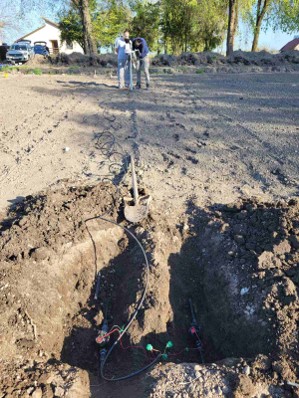
The larger parcels (ranging from approximately 46 to 77 hectares) are equipped with center pivot irrigation systems, enabling efficient water distribution over extensive crop areas. In contrast, the vegetable production site (approximately 1 hectare) utilizes a subirrigation system, which allows precise water delivery directly to plant roots.
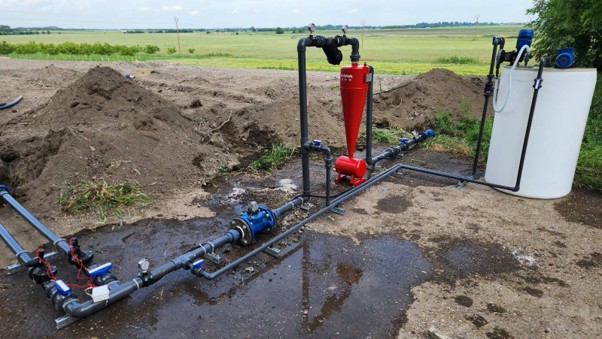
The pilot’s infrastructure includes advanced irrigation networks with valves, pipelines, and multiple irrigation zones. These zones enable controlled experimentation, including comparisons between irrigated and non-irrigated conditions, as well as different treatment variants.
This site was selected due to its diversity in crops, irrigation systems, and scalability potential. It provides an ideal environment for testing both conventional and innovative agricultural practices while generating insights applicable to a wide range of farming contexts.
Crops Under Study
The pilot focuses on a combination of large-scale field crops and high-value vegetable crops.
On the larger fields, the main crops include:
- Spinach
- Parsley
- Corn
These crops were selected due to their economic importance and varying water requirements, making them well suited for testing irrigation optimization strategies.
In the dedicated vegetable plot, the pilot focuses on:
- Tomatoes
- Peppers
- Watermelon
These crops are cultivated under a controlled subirrigation system, making them ideal for testing innovative solutions related to water management and nutrient delivery.
By combining different crop types and cultivation systems, the pilot addresses a wide range of agricultural challenges, including water-use efficiency, yield optimization, and resilience to environmental variability.
Solutions to be Implemented
As Pilot #1, Terra Littera plays a central role in implementing a combination of Nature-Based Solutions (NBS) and IT-based innovations, ensuring their practical application at farm level.
Nature-Based Solutions
The pilot introduces several sustainable and circular approaches, including:
- Rainwater harvesting, storage, and reuse systems to improve water availability
- Agroecological practices, including BioWAG (biological water-absorbing geo-composites), superabsorbent polymers, and other water-retaining materials
These measures aim to reduce dependency on freshwater resources, improve soil moisture retention, and strengthen resilience to climate variability.

IT-Based Solutions
Alongside nature-based approaches, the pilot deploys advanced digital technologies:
- AI-based smart irrigation systems for optimized water use
- Sensor networks for monitoring soil and environmental conditions
- Data-driven tools for decision support and farm management
These technologies enable precise, real-time irrigation control and significantly improve resource efficiency.
Innovation and Impact
What makes Pilot 1 particularly innovative is its integrated approach, combining circular water management with digital intelligence. Unlike conventional methods based on fixed irrigation schedules, this pilot adopts a dynamic, data-driven and circular model, where water is continuously monitored, reused, and optimized.
In addition, Terra Littera contributes to training and education for farmers and decision-makers, supporting the adoption and scalability of these innovative practices.
Equipment and Technology
The pilot integrates a range of advanced technologies designed to improve efficiency and sustainability:
- Center pivot and subirrigation systems
- Automated solenoid latching valves for irrigation control
- Sensor stations for environmental monitoring
- Digital field mapping and crop representation tools
These technologies enable precise irrigation management and provide real-time data to support informed decision-making. The use of multiple irrigation zones allows experimentation with different strategies and performance comparisons.
The expected outcomes include improved water-use efficiency, increased crop productivity, and reduced operational costs.
Challenges and Opportunities
The pilot faces several challenges, including integrating new technologies into existing farming systems, managing environmental variability, and ensuring reliable data collection across different field conditions.
However, these challenges also create opportunities. As Pilot #1, Terra Littera is uniquely positioned to demonstrate how innovative, scalable solutions can be applied in real agricultural environments. The pilot also fosters strong collaboration with farmers, encouraging knowledge transfer and wider adoption of sustainable practices.
What comes next
Looking ahead, the pilot will continue to explore how nature-based and digital solutions can support more efficient and sustainable water management in the field.
Over the coming growing cycles, field data will help show how these solutions perform in real conditions and how they can contribute to better water-use efficiency, crop productivity and more sustainable farm management.
These results will offer valuable insights into how smart irrigation, circular water management and agroecological practices can work together in practice.