In Poland, GEORGIA is testing how BioWAG water-retaining materials can support crops under variable water conditions, from field plots to greenhouse trials. The pilot focuses on practical ways to retain moisture close to the root zone and improve crop performance during dry periods.
The work takes place at Swojec Experimental Station, operated by the Wrocław University of Environmental and Life Sciences (UPWr). The station is situated in the Odra Valley floodplain in north-eastern Wrocław, between the Odra and Widawa rivers (51°07’01.6″N 17°08’30.1″E). Its location between two rivers causes seasonal groundwater level fluctuations based on regional rainfall and river water level. Due to fine texture and alluvial origin, mainly Fluvisols, the soils have good capacity for water storage. However, the terrain is susceptible to periodic waterlogging during heavy precipitation or flood events, as well as seasonal water deficits during dry summers. Most of the land falls under high to medium agricultural soil classes (II–IV), making it exceptionally well-suited for arable crop experiments, vegetable farming and soil management research.
What are we testing?
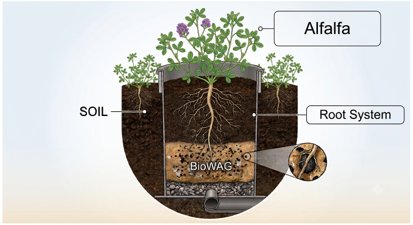
We are testing different modifications of BioWAG, which is a composite material made of three main components: a superabsorbent polymer (SAP), an internal support structure, and a biodegradable nonwoven fabric made from natural materials like sheep wool or flux fiber. The superabsorbent component acts as a small water reservoir: it absorbs water from rainfall or irrigation and temporarily retains it. The stored water is then uptaken by plant root system, allowing plants to access moisture for a longer period. We are testing BioWAG with different irrigation strategies, including rainwater harvesting and storage. The water is delivered to plants only during the first growing phase to support vegetation development. After full development of the root system the plants will be only supported by water from rainfall and BioWAG.
The aim of the pilot study is to evaluate whether BioWAG water- retaining materials produced from circular variants, microorganisms and rainwater reuse can improve soil water retention and crop performance under small-plot field and greenhouse conditions. The monitoring focuses on treatment-level comparison, as the field experiment is small, there is no existing permanent irrigation network, and sensors will be installed only in selected representative plots.
How do we test it?
We have established two experimental plots with two tested plant species: mixed grass and Alfalfa (Medicago sativa L.) and we are testing different variants of BioWAG with different irrigation regimes, however our plot is mainly supported with water from rainfall directly or by collecting rainfall from rooftop of farm building and delivering it to the field when needed by irrigation system. The field that we are using for testing is one of the driest locations at the farm. Soil texture is a loose sand with very low capacity for nutrient and water storage. This part of the farm straggles with the problem of soil dryness during hot summer seasons, yields of crops are much lower (even 30% compared) to other parts of the experimental farm and we hope that our BioWAG system will solve the water shortage problem in this area and support the plant growth even in such an extreme weather that we have this summer in Poland.
During the experiment we monitor different parameters and compare BioWAG, BioWAG+microorganisms, BioWAG + biochar and new BioWag variants. We quantify rainwater harvest and collect other meteorological data, including precipitation and air temperature. We also monitor water consumption in comparison with control plots where BioWAG was not applied. Finally, our research also focuses on plants and we asses plant growth parameters, biomass, yield, nutrient content to have a complete overview of how BioWAG system works and supports plants in growth.
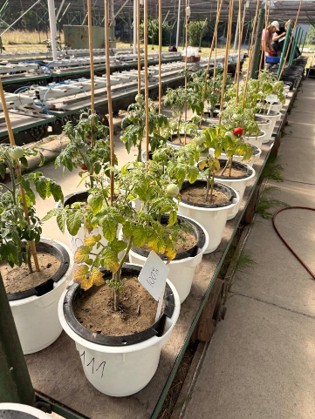
Our solution is also tested in a greenhouse. We are growing tomatoes with/or without BioWAG system and testing how the plants respond to different water regimes, quantifying the yields and benefits resulting from the use of the system and the reduction of the irrigation level. We also conduct quality tests on tomatoes, assessing their flavor, sugar, vitamin C, and lycopene content to determine whether the system we have implemented has an impact on product quality.
Why can BioWAG be successful in supporting plant growth?
A standard BioWAG mat measuring 25 × 25 × 2 cm can absorb approximately 1.0–1.5 liters of water, although the exact amount depends on field conditions, such as water salinity or the load of soil on the material. After rainfall or subsequent irrigation, the material can be refilled with water, creating a repeated cycle of absorption, storage, and gradual uptake. This makes BioWAG particularly relevant for agricultural systems exposed to seasonal water stress. It can help reduce water losses caused by evaporation, decrease irrigation frequency, and improve water-use efficiency during dry periods. This creates a more circular and resilient approach to water management: water is collected, stored, delivered to the soil, and then retained close to the roots instead of quickly draining beyond their reach.
What is the advantage of using BioWAG instead of synthetic absorbents?
BioWAG is made of almost fully biodegradable components and as a biodegradable material, BioWAG does not need to be removed from the soil after use. Over time, it decomposes naturally, releasing nutrients to soil, mainly N and K from sheep wool and biochar decomposition. Depending on the material used and local conditions, its functional lifetime may range from one to several growing seasons. BioWAG can also be enriched with selected beneficial microorganisms. These microorganisms may support biological processes occurring in the root zone, such as nutrient cycling. As a result, BioWAG has the potential to combine water-retention functions with additional benefits for the soil.
The BioWAG system is also implemented in other pilot activities in northern Serbia, and in northern Bulgaria. These pilots are important, because the effectiveness of BioWAG depends on local conditions, such as soil type, climate, vegetation, biological activity, and irrigation management. Testing the material in different environments makes it possible to better understand where it works best, how long it remains effective, and how it can be adapted to different crops and farming systems.