Across six European countries, the project is implementing complementary approaches to capture water, retain it in the soil and safely return recycled water and nutrient resources to agriculture.
The Horizon Europe GEORGIA project is advancing the implementation of seven pilot demonstrations across Serbia, Bulgaria, Полша, Austria, Cyprus and Greece (Santorini and Peloponnese) . With the technical configurations and monitoring plans now defined, the pilots are progressing through installation, commissioning and early operation across arable fields, vegetable production systems, greenhouses, orchards and vineyards. Rather than relying on a single technology, GEORGIA combines complementary irrigation mechanisms that address three essential challenges: increasing the availability of alternative water sources such as rainfall or atmospheric condensate, improving water retention in the soil, and safely recycling water and nutrients for agriculture.
Increasing the availability of alternative water sources
In Serbia, Bulgaria and Poland, rainwater is collected from building roofs, stored and made available for crop establishment and supplementary irrigation. Landscape-based systems are also being implemented to manage rainfall closer to where it falls. Retention ponds and earth-dug terraces in Bulgaria and Austria capture surface runoff, slow its movement and support infiltration or later irrigation. In Cyprus, half-moon-shaped basins collect rainfall around citrus trees, while atmospheric condensation systems in Austria, Cyprus and Santorini are being tested as complementary sources of locally available water.
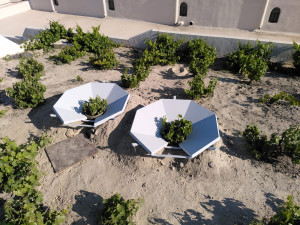
Passive atmospheric water collection in vineyards through Kouloura dew condensartion units at the pilot site in Santorini, Greece
Improving water retention in the soil
Биологични Водоабсорбиращи Геокомпозити, an innovative biodegradable soil additive designed to improve water retention directly in the plant root zone, is being tested in Serbia, Bulgaria and Poland. The material helps retain moisture around the roots and releases it gradually to the crops. The Polish demonstrations include several formulations containing microorganisms, biochar and biodegradable residues such as waste wool and wood. GEORGIA is also examining cover crops in Bulgaria and sludge–biochar amendments in Cyprus as approaches that can improve soil condition, strengthen water retention and support more resilient production.
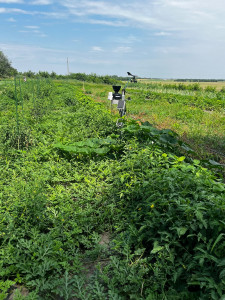
Increased soil water retention through sub-surface installed BioWAGs at the GEORGIA pilot site in Serbia
Recycling water and nutrients for agriculture
In Austria, a vertECO® green-wall system treats domestic wastewater for irrigation and fertigation of a market garden, while a planted reed bed stabilises sewage sludge for its potential future use as a soil amendment. In Cyprus and at Greek sites on Santorini and the Peloponnese, automated irrigation control and monitoring are being used to optimise the reuse of treated municipal wastewater on citrus fruits, vineyards and other perennial crops. Also, as part of the experimental set-ups, its use is assessed as an alternative to more conventional water sources such as groundwater and desalinated water.
The next phase will focus on operating and evaluating these mechanisms across cultivation seasons. Water use, soil conditions, fertiliser inputs, crop performance and operational requirements will be monitored against pilot-specific baselines. The results will help determine in which contexts the different mechanisms are most effective, what conditions are required for their safe operation and how they could be adapted to other European farming contexts.
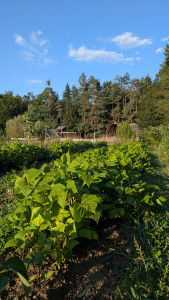
Treated wastewaterreuse in a Market garden at the GEORGIA pilot site in Austria