Smart Water Management takes root in the Peloponnese
Luglio 16, 2026
New field monitoring activities in Corinth are laying the foundations for GEORGIA’s large-scale pilot on reclaimed water and data-informed irrigation.
The Peloponnese pilot is centred on the Corinth area and addresses one of Mediterranean agriculture’s most urgent challenges: how to use water more efficiently while reducing pressure on conventional freshwater resources.
The wider pilot context includes grapes, lemons, olives, vegetables and avocados. At regional scale, the planned scope reaches more than 500 hectares and around 300 farmers, connecting field monitoring with the realities of a broader agricultural community.
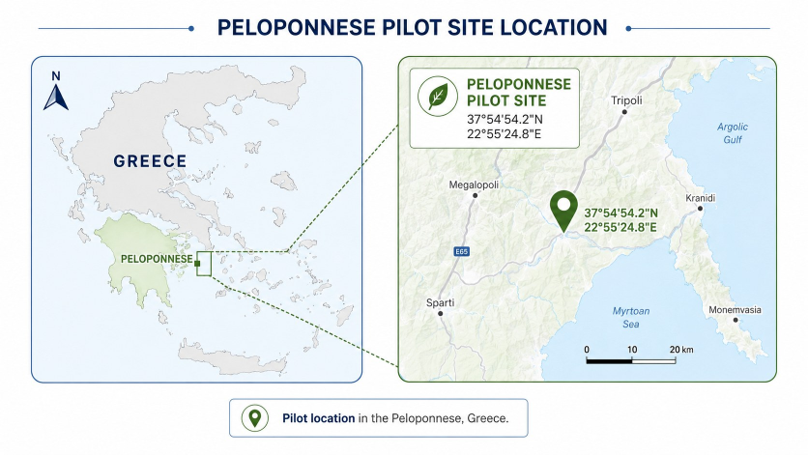
Peloponnese pilot site location based on the provided coordinates.
A regional pilot with a practical objective
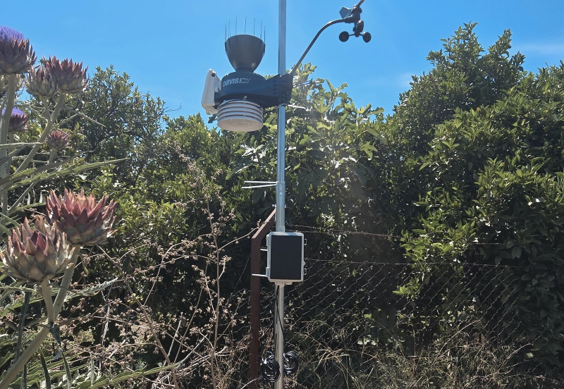
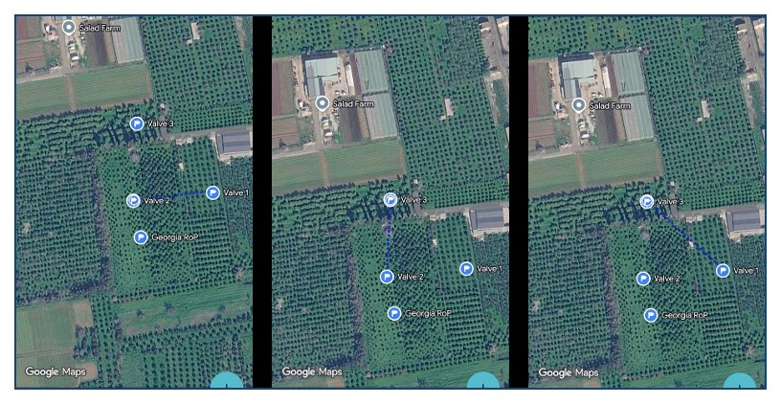
In the orchards around Corinth, GEORGIA is establishing a practical field-monitoring setup to support smarter water management in the Peloponnese pilot. SynField equipment is positioned at selected monitoring points within the pilot orchards, combining a compact agrometeorological station with solar-powered field nodes that collect local information from the production environment.
These installations help build the local evidence base for future stages of testing and validation. Weather, soil and crop conditions can vary considerably even across neighbouring fields, making site-specific observations essential for practical irrigation decisions.
SynField agrometeorological station in the Peloponnese pilot area. Photo: SYN / GEORGIA.
From field information to better decisions
Field monitoring will be combined with water-quality observations and other GEORGIA services to support practical questions: when is irrigation really needed, how do weather and local field conditions affect demand, and how can available water be shared more effectively among users?
Why this matters for water and fertiliser efficiency
The pilot is designed to reduce avoidable resource waste. Instead of applying water or fertiliser according to fixed routines, the system will support decisions that respond to local weather, crop and field conditions. For the Peloponnese/Korinthos pilot, GEORGIA targets more than 60% average irrigation-water reduction and more than 35% average reduction in synthetic fertiliser use, while also validating treated-water quality and smart-irrigation automation under real orchard conditions.
Resource-efficiency targets for the Peloponnese/Korinthos pilot. Values are project validation targets.
What happens next?
The pilot will generate feedback from farmers and local stakeholders, confirming that the proposed services are reliable, understandable and compatible with everyday farm operations.
Next steps include confirming stable data transmission, building a baseline of local field conditions, linking in-field observations with water-quality information, and gradually testing smart irrigation and water-sharing functions.
By bringing water-treatment infrastructure together with farm-level monitoring and stakeholder involvement, the Peloponnese pilot moves circular water management closer to agricultural practice.
Field nodes and indicative valve layout used for pilot monitoring and irrigation management. Source: SYN / Google Maps basemap.