


Water scarcity is becoming one of the most important challenges in modern agriculture. In many regions, farmers are increasingly facing longer drought periods, irregular rainfall, and a growing need to use water resources more efficiently. This is particularly difficult in soils with low water-retention capacity, such as sandy or sandy-loam soils, where moisture can quickly move beyond the reach of plant roots.
This is where Биологични Водоабсорбиращи Геокомпозити comes in. BioWAG, or biological/biodegradable water-absorbing geocomposites, is an innovative, biodegradable soil additive designed to improve water availability directly in the root zone – the part of the soil from which plants actively take up water and nutrients. Instead of evenly retaining water across the entire field, BioWAG focuses on where water matters the most: around the roots.
What is BioWAG?
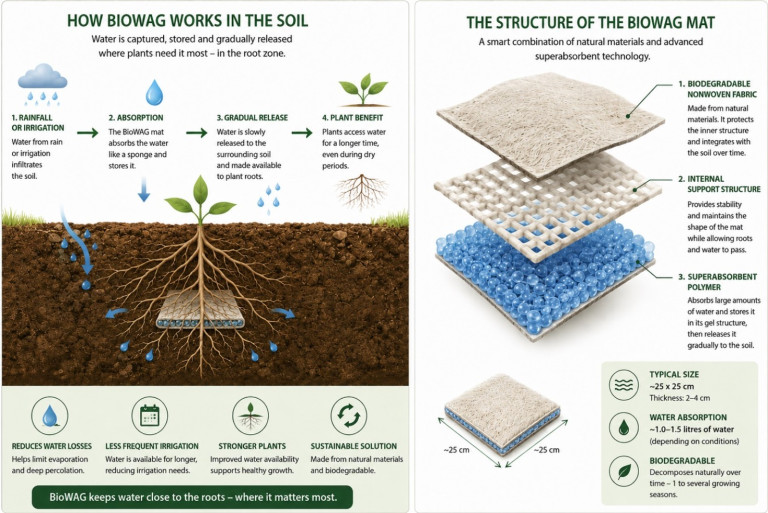
Биологични Водоабсорбиращи Геокомпозити is a composite material made of three main components: a superabsorbent material (SAP), an internal support structure, and a biodegradable nonwoven fabric made from natural materials. The superabsorbent component acts as a small water reservoir: it absorbs water from rainfall or irrigation and temporarily retains it. The stored water is then gradually released into the surrounding soil, allowing plants to access moisture for a longer period.
As a biodegradable material, BioWAG does not need to be removed from the soil after use. Over time, it decomposes naturally. Depending on the material used and local conditions, its functional lifetime may range from one to several growing seasons. BioWAG can also be enriched with selected beneficial microorganisms. These microorganisms may support biological processes occurring in the root zone, such as nutrient cycling. As a result, BioWAG has the potential to combine water-retention functions with additional benefits for the soil.
How does BioWAG work in practice?
BioWAG is installed below the soil surface, close to plant roots. One of the most commonly used forms is a mat measuring approximately 25 × 25 cm and 2-4 cm thick. Roots can grow through the mat or develop around it, gaining access to the water stored inside.
A standard BioWAG mat measuring 25 × 25 × 2 cm can absorb approximately 1.0–1.5 litres of water, although the exact amount depends on field conditions, such as water salinity or the load of soil on the material. After rainfall or subsequent irrigation, the material can be refilled with water, creating a repeated cycle of absorption, storage, and gradual release. This makes BioWAG particularly relevant for agricultural systems exposed to seasonal water stress. It can help reduce water losses caused by evaporation, decrease irrigation frequency, and improve water-use efficiency during dry periods.
Where can BioWAG be used?
BioWAG is particularly well suited to crops grown in soils with low water-holding capacity or in places where water availability is uncertain. It can be used in both annual and perennial crops, and may be especially useful when establishing young trees, shrubs, or other plants that require stable moisture conditions during the early stages of growth.
This technology is best suited to situations where local, spot application is possible-for example, placing one BioWAG mat in a planting hole near an individual plant. In very large field systems, implementation may be more difficult due to installation costs and logistics. However, in spot applications, BioWAG offers a practical way to concentrate water retention exactly where it is needed.
BioWAG can also be combined with integrated irrigation strategies, including rainwater harvesting and storage. This creates a more circular and resilient approach to water management: water is collected, stored, delivered to the soil, and then retained close to the roots instead of quickly draining beyond their reach.
BioWAG in the GEORGIA project
Within the Проект GEORGIA, BioWAG supports the broader goal of transforming water management for more resilient agriculture. The project focuses on innovative solutions in irrigation and water retention that can help agricultural systems adapt to climate change-related water stress.
BioWAG is being implemented in pilot activities in northern Serbia, in south-western Poland, and at a pilot site in northern Bulgaria. These pilots are important because the effectiveness of BioWAG depends on local conditions, such as soil type, climate, vegetation, biological activity, and irrigation management. Testing the material in different environments makes it possible to better understand where it works best, how long it remains effective, and how it can be adapted to different crops and farming systems.
A small material with great potential
BioWAG is not a universal solution to all water-related problems in agriculture. Its effectiveness changes over time as the material biodegrades, and the material itself must be properly selected and installed according to site-specific conditions. However, the basic idea behind BioWAG is simple and very promising: to retain water close to the roots, release it gradually, and support plants during periods of limited rainfall.
By combining biodegradable materials, water-retention capacity, and the possibility of enrichment with microorganisms, BioWAG represents an innovative step towards more resource-efficient and climate-resilient agriculture. In the GEORGIA project, it demonstrates how an intelligently designed material can contribute to practical solutions for one of the most urgent challenges in agriculture: making every drop of water count.
References
Marczak, D., Lejcuś, K., Kulczycki, G., & Misiewicz, J. “Towards circular economy: Sustainable soil additives from natural waste fibres to improve water retention and soil fertility.” Science of the Total Environment, 844, 2022. https://doi.org/10.1016/j.scitotenv.2022.157169
Marczak, D., Lejcuś, K., Lejcuś, I., & Misiewicz, J. “Sustainable Innovation: Turning Waste into Soil Additives.” Materials, 16(7), 2023. https://doi.org/10.3390/ma16072900
Marczak, D., Lejcuś, K., Grzybowska-Pietras, J., Biniaś, W., Lejcuś, I., & Misiewicz, J. “Biodegradation of sustainable nonwovens used in water absorbing geocomposites supporting plant vegetation.” Sustainable Materials and Technologies, 26, 2020. https://doi.org/10.1016/j.susmat.2020.e00235


